
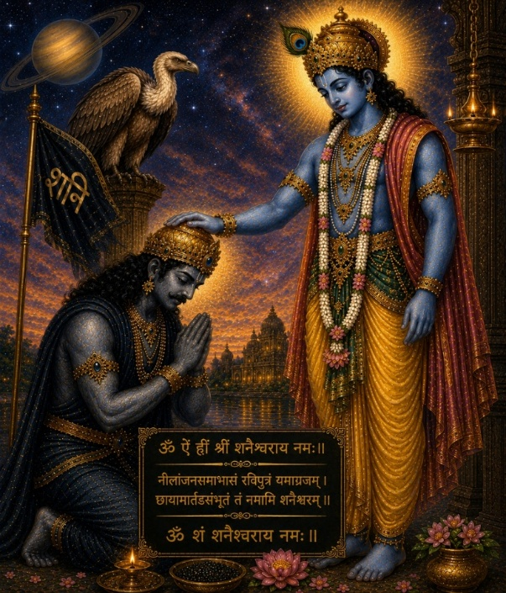
Lord Surya Narayan of the Kashyapa gotra had ten children. From his wife Sanjna — daughter of Lord Vishwakarma (the divine Leela Shakti of Lord Surya Narayan) – were born Vaivasvata Manu, Yama, Yami (Yamuna), the Ashwini Kumars, and Revata. From Chhaya – the concealed power of Sanjna, who is also the Atma Shakti of Lord Surya Narayan – were born Shani Dev, Tapati, Vishti (Bhadra), and Sarani Manu. Shani Dev was born on the day of Jyeshtha Krishna Amavasya. The radiance of Shani Dev’s body resembles the blue sapphire gem. On his head rests a golden crown, a garland adorns his neck, and he is dressed in blue garments. Shani Dev holds a bow, arrow, trident, and the Vara-mudra (boon-granting gesture) in his hands. Shani Dev rides upon a vulture, whose very sight of movement perceives the Lord’s contemplative power.
In the Puranas, “Chhaya” does not merely mean shadow or reflection, but also “restraint” and “austerity (tapa).” From Chhaya (Atma Shakti/the Soul-Power), the element of bliss can arise. Austerity leads to devotion; devotion leads to knowledge and detachment; and knowledge and detachment lead to supreme Vaishnava state – meaning “Even darkness, if turned toward God, becomes the path to liberation.” This is why Shani Dev is regarded not merely as a deity of fear, but as the inspirer of karma, justice, austerity, and ultimately, the attainment of God.
According to Skanda Purana and Shani Dev Mahatmya, from childhood Shani Dev received the Shani Dev received the blessings of Lord Mahadev as his Sadguru Bhagavan and performed intense austerities for the worship of Lord Shrikrishn.
एते चांशकलाः पुंसः कृष्णस्तु भगवान् स्वयम्। इन्द्रारिव्याकुलं लोकं मृडयन्ति युगे युगे॥
“All other deities and incarnations are parts or portions of the Supreme Being, but Krushn alone is the Supreme Lord Himself”. The selfless devotion of Shani Dev toward Lord Krishna – without desire for gain, reward, or personal benefit – elevated him beyond merely being the giver of karmic results. Lord Krishna, pleased with this devotion, made him a symbol of divine knowledge and detachment, and granted Shani Dev a place among the Navagrahas (nine planets).
कर्म प्रधान विश्व करि राखा। जो जस करइ सो तस फलु चाखा॥
In the Vishnu Purana, Lord Krishna is described as the controller of karma. Therefore, Shani Dev is the representative of Lord Krishna’s form of justice — this is why Shani Dev delivers judgment according to one’s karma without distinction, whether human or divine, animal or bird, king or pauper, and dispenses the results of karma without bias, whether the karma is from this life or a previous one.
The Unity of Shani Dev and Lord Surya Narayan
1. Love of Justice: Lord Surya Narayan is regarded as the witness of the entire universe – the illuminator of truth, observer of righteousness, and the giver of life. Similarly, Shani Dev is considered the judge of karma, impartial giver of results, and the punisher of unrighteousness. The “truth-light” of Lord Surya Narayan descended into Shani Dev as “justice of karma.”
2. Radiance Hidden in Detachment: Lord Surya Narayan removes outer darkness; Shani Dev removes inner ego and attachment. Both aim ultimately at self-awakening.
3. Impartiality: Lord Surya Narayan gives equal light to all — king or poor, saint or sinner. Similarly, Shani Dev grants karmic results equally to all without discrimination.
In the midst of the worldly relationships of this mortal world – such as between a father and son – it is entirely possible that there may be a difference of opinion (mat-bhed) rather than a difference of heart (man-bhed). This is nothing unusual. And if the reason for that difference of opinion is related to upholding the values of Sanatan Dharma, or to attaining selfless loving devotion toward God, then such a difference of opinion is considered welcome and worthy of respect. As an example: at the very beginning of the creation of this universe, the very first and most exalted children (the Sanakadi Rishis) clearly and outright refused to follow the command of their father, Lord Brahma!
Is Shani Dev’s Gaze Truly “Cursed”?
Some traditions mention symbolic stories of curses related to Shani Dev’s association with household principles such as wife, mother, or goddess. These are merely symbolic teachings that excessive detachment without worldly balance may create disharmony in family life. But in truth, the divine narrative of Lord Shani Dev teaches:
अप्रायत्यादात्मनस्ते दोषान् मौहूर्तिकादुत । मन्निदेशातिचारेण देवानां चातिहेलनात् ॥
“A householder whose mind is tainted by worldly desires has no sense of time; they neither heed the words of a saint nor obey divine command and ultimately produce inauspicious results in society.”
एतावान् साधुवादो हि तितिक्षेतेश्वरः स्वयम् ॥
“True saintliness is to tolerate wrongs done even by one’s own family, despite having the power to retaliate.”
नारायणपरा: सर्वे न कुतश्चन बिभ्यति । स्वर्गापवर्गनरकेष्वपि तुल्यार्थदर्शिन: ॥
Those who have surrendered to God fear nothing in worldly life – marital, familial, or social because they only perceive the Lord in heaven, whether in liberation, or even in hell.
वासुदेवे भगवति भक्तिमुद्वहतां नृणाम् । ज्ञानवैराग्यवीर्याणां न हि कश्चिद् व्यपाश्रय: ॥
Those who possess the strength of knowledge and detachment, and who maintain devotion to Lord Krishna, are personally protected by the Lord Himself.
In this Kali Yuga, the one soul whom Lord Krushn personally took to Golok-Dham in bodily form through the grace of Lord Shiva was Narsinh Mehta. Narsinh Mehta regarded remembrance of the Lord’s name as the supreme purpose of life and gave devotion greater importance than marital, familial, or social bonds. Yet this does not mean he disrespected his wife or abandoned household duties. Rather, he considered remembrance of the Lord as the ultimate truth and highest priority of life. “The relationship that leads one toward God is the only true relationship.”
Therefore, in truth, the symbolic meaning of Shani Dev’s downcast/lowered eyes is transformative. A downward gaze symbolizes humility and detachment; a stern gaze symbolizes the destruction of ego; avoiding a direct gaze symbolizes compassion through restraint. Thus, Shani Dev’s gaze is not cursed. True justice is impartial, restrained, and free of ego. Shani Dev first destroys false pride, then builds true character.
Shani Dev Comes Not to Frighten, But to Reform!
How could Shani Dev, the supreme devotee of Lord Krishna, intentionally cause suffering to anyone? When a person becomes trapped in ego, injustice, deceit, laziness, or unrighteousness, Shani Dev creates situations through which that person can recognize their own karma. This is more awakening than punishment. Hence it is said: “Shani Dev does not destroy the individual – he destroys the ego.”
Science does not say that planets punish anyone. But science does acknowledge that every action has a consequence, habits shape life, discipline leads to success, and an unhealthy lifestyle creates stress. This is precisely the principle of Shani Dev – “the result of karma.” For example: if a person is lazy → financial problems will increase; if a person is short-tempered → relationships will break; if a person is undisciplined → health will deteriorate. This is not Shani Dev’s curse, but the “law of cause and effect”.
Why did fear of Shani Dev spread? Because humans fear difficulty, fear change, and do not wish to confront the consequences of their own actions. Thus, they turned Shani Dev into a symbol of fear.
What does the eternal truth say? The fundamental basis of Sanatan Dharma is not fear, but the evolution of consciousness. Lord Krishna repeatedly taught karma, balance, self-control, and fearlessness in the Bhagavad Gita. Therefore, the true way to understand Shani Dev is: “He does not take us away from God, but he prepares us to become worthy of God’s grace.”
What Is Considered the Supreme Worship of Shani Dev?
Truthfulness and honesty – because Shani Dev is the deity of karma and justice. He becomes pleased through service to the suffering, poor, elderly, sick, and neglected. Ego is regarded as most displeasing to him. When a person becomes humble, accepts their mistakes, regards righteous conduct as the highest worship, and sees life as a gift from God, Shani Dev becomes pleased. Regular spiritual practice, respect for time, disciplined living, and patience are dear to Shani Dev.
Shani Dev is pleased by the darshan and by loving devotion to Lord Hanuman – the living embodiment of servant-dharma, because such servant-dharma devotion is the most difficult form of Bhagavat Dharma, which even the Lord described as superior to yogic paths – the path of practical divine service. सिर भर जाउँ उचित अस मोरा। सब तें सेवक धरमु कठोरा॥
What Is the Sign of a True Devotee of Shani Dev?
One in whom purity and simplicity overflow! That spiritually mature elder from whose gaze the world has departed, who has come very close to the Absolute, whose gaze has become fixed on the Absolute, and who is naturally absorbed in Supreme Bliss — serving such a spiritually mature devotee means serving the Absolute… serving the essence of Shri Krishna… serving the Beloved of Shani Dev… therefore, service to Shani Dev Himself.
Service to the Poor, Disabled, and Laborers
This is considered the highest form of Shani worship. Shani represents those afflicted, neglected, poor laborers, and those who bear burdens. In Shani worship, special emphasis is placed not merely on ritual procedures, but on humanitarian service. Helping the poor, sick, and disabled selflessly and without any show is considered the truest form of Shani devotion.
Shami Tree
The Shami tree survives in desert conditions, dry climate, harsh heat, poor soil, and scarce water – yet serves silently without complaint, stays connected to its roots even under pressure, protects others even amid hardship, and grows slowly but steadily. These qualities directly reflect the spiritual qualities of Shani Dev – endurance, firmness, discipline, and perseverance through pain. The deepest connection between the Shami tree and Shani Dev is that true strength is peaceful, patient, disciplined, and revealed in adversity.
The “Symbolic” Significance Behind Items Used in Shani Worship
Black Sesame Seeds: Sesame symbolizes surrender of ego and the burning away of accumulated karma. Its black color is associated with Shani’s nature and symbolizes absorption of negativity, calming inner intensity, renunciation of ego, stability, spiritual purification, and connection to the earth. These principles ultimately become purification of karma, peace for ancestors, humility, and transformation of energy.
Mustard Oil: Offering mustard oil demonstrates willingness to surrender something of material value. Since Shani governs the poor and laboring classes, donating oil is a symbol of solidarity and empathy. It dissolves attachment to ego and wealth. Mustard oil is sharp, deeply penetrating, and purifying. It symbolizes removal of laziness, awakening, and destruction of hidden negativity.
Black Lentils (Urad Dal): The black color of urad represents Shani’s absorbing and transformative power. Offering a nourishing substance to the deity who governs bodily limitations (bones and nerves) represents symbolic acceptance of cosmic law.
Iron Objects: The heaviness and strength of iron represent Shani’s qualities — discipline, endurance, and the burden of karma. This is a symbolic resonance with Shani’s energy, and a symbolic connection with Shani’s serious, stable, and unwavering nature.
Crow: A crow sees things that ordinary people ignore. Honoring the crow cultivates humility because Shani’s grace is attained through service to the neglected, forgotten, and ancestors. This is practice in seeing divinity even in what is considered lowly or ordinary. Crows are also regarded as “symbols of subtle signs and warnings.”
The Essence of Shani Worship Elements
तिलतैललोहमात्रेण न शान्तिः जायते ध्रुवम् । शुद्धभावेन कर्मैव शनिदेवः प्रसन्न्यति ॥
Peace is not achieved merely by sesame, oil, or iron; Lord Shani Dev is only pleased by pure conduct and righteous action.
The basis behind the items offered in Shani worship is rational and profound, not arbitrary. In Vedic astrology, Shani governs the masses, service, and the results of karma without bias. Therefore, Therefore, Shani worship expresses solidarity with the poor and suffering – you offer useful things to the poor. Shani is the only planetary deity who never allows karma to be bypassed through flattery or bribery. Thus, worship of Shani is not merely for asking favors, but for accepting the ‘law of cause and effect’, cultivating patience, and practicing humble service.
Lord Shani Dev and the Concept of – शनैः शनैः
Slowly, gradually, gently, step by step… This phrase itself carries a deep spiritual meaning – divine realization does not happen by force; it ripens slowly. Just as morning comes gradually, a seed slowly becomes a tree, consciousness awakens gradually – so too does true devotion mature slowly at the feet of God.
शनैः शनैरुपरमेद् बुद्ध्या धृतिगृहीतया । आत्मसंस्थं मनः कृत्वा न किञ्चिदपि चिन्तयेत् ॥
“Step by step, with steady intelligence and patience, one should bring the mind toward spiritual steadiness.” This principle is one of the strongest scriptural foundations that spiritual progress happens slowly and steadily.
शृण्वतां स्वकथाः कृष्णः पुण्यश्रवणकीर्तनः । हृद्यन्तःस्थो ह्यभद्राणि विधुनोति सुहृत्सताम् ॥
“By listening to and chanting the name of Lord Krishna, the impurities of the heart are gradually removed.” The purification of the heart is described as a gradual ongoing process.
गुणरहितं कामनारहितं प्रतिक्षणवर्धमानम् ।
“Pure devotion is selfless and increases with every passing moment.” Devotion is something that continuously and gradually develops over time.
स तु दीर्घकालनैरन्तर्यसत्कारासेवितो दृढभूमिः ॥
In many spiritual traditions, especially Sanatan Dharma, the slow process of devotion is regarded as the most stable and authentic path, because true devotion is not merely an emotional moment – it is gradual transformation of the heart, mind, habits, ego, and consciousness. Quick enthusiasm may touch emotions, slow devotion shapes character.
Ego dissolves gradually. Ego is one of the greatest obstacles between the soul and the Supreme. It rarely disappears instantly. Through service, prayer, chanting the divine names, surrender, and self-reflection, it slowly softens. This gradual process makes the heart spiritually receptive.
The divine relationship is organic, not mechanical. Genuine love cannot truly arise instantly. Gradual divine practices such as hearing about God, chanting, remembrance, service, and surrender prevent devotion from becoming superficial. Slow devotion is not delay; it is the maturation of consciousness toward God.
Shani’s Sade-Sati Is Actually a Process of Purification — A Grand Yagna!
The fundamental question is: why do people fear the Sade-Sati? Because they understand, “Shani Dev has come to punish.” But the truth is: “Shani Dev has come to take back everything that was never truly yours.” This is the difference between fear and liberation.
The Structure of Sade-Sati — Three Phases, Three Purifications
Phase 1 (First 2.5 years – Shani Dev preceding the birth sign): Purification of the outer world. Shani Dev first breaks external identity: relationships break, wealth goes, position is lost, reputation shakes. Because humans have created false identities: “I am what I possess.” “I am what others think of me.” “I am my position.” Shani Dev takes all this away and asks: “Now tell me – who are you?”
Phase 2 (Second 2.5 years – Shani Dev on the birth sign): Burning of the inner self. When all outer things are gone, the inner falsehoods surface: ego (“I am the best”), attachment (“This will last forever”), selfishness (“Everything is for me”). Just as gold is purified – first taken from the mine, then put into fire – and pure gold emerges; Shani Dev is that very fire of refinement.
Phase 3 (Third 2.5 years – Shani Dev after the birth sign): The emergence of a new form. When everything burnable has burned away, the true self appears. Genuine relationships remain, contentment arises, inner strength awakens, and faith develops. Shani Dev now rebuilds – and what is rebuilt becomes lasting.
Shani Dev Brings Three Questions:
Question 1: “What did you accumulate that was never truly yours?” → It is taken away.
Question 2: “With whom did you commit injustice?” → Similar circumstances must then be experienced personally.
Question 3: “What is your true nature?” → When the answer is realized, the Sade-Sati ends.
Shani Dev knows that the soul’s true identity is a fragment of Krishna. But the soul has wrapped itself in illusion. In the Sade-Sati, Shani Dev lifts that illusion (veil of maya). Shani Dev is truly a messenger of Krishna who frees the soul from the illusion maya and pushes it toward Krishna.
तत्तेऽनुकम्पां सुसमीक्षमाणो भुञ्जान एवात्मकृतं विपाकम् । हृद्वाग्वपुर्भिर्विदधन्नमस्ते जीवेत यो मुक्तिपदे स दायभाक् ॥
One who accepts the hits of Shani Dev as divine grace becomes purified quickly and completely. Sade-Sati is the furnace in which the iron of “I” and “mine” burns away, and the gold of “He” and “His” emerges. When the false “I” disappears, Krishna becomes visible. This is the greatest gift of Shani Dev. This is his causeless compassion. This is the purpose of his devotion to Krishna.
Shani Dev as a Planet According to Astrology
According to astrology, Shani Dev’s chief deity (Adhidev) is Yamaraj and his secondary deity (Pratyadhidev) is Prajapati Brahma. Shani Dev resides in one zodiac sign for thirty months. Shani Dev is the lord of Capricorn and Aquarius. His exaltation sign is Libra, and his debilitation sign is Aries. Shani Dev’s Mahadasha (major period) lasts 19 years. In palmistry, Shani Dev’s mount is located below the middle finger. According to numerology, the dates 8, 17, and 26 of every month are governed by Shani Mantras of Shani Dev.
Meditation Mantra: इन्द्रनीळ–द्युतिः शूळी वरदो गृध्रवाहनः। बाण–भाण–आसन–धरः कर्तव्योऽर्कसूत–स्तथा॥
Vedic Mantra: ॐ शंनो देवीरभिष्टय आपो भवन्तुपीतये। शंयोरभि स्रवन्तुनः॥
Puranic Mantra: नीलाञ्जनसमाभासं रविपुत्रं यमाग्रजम्। छायामार्तण्डसम्भूतंतंनमामि शनैश्चरम्॥
Beej Mantra: ॐ प्रांप्रीं प्रौं सः शनैश्चराय नमः॥
Mool Mantra: ॐ शं शनैश्चराय नमः॥
Navagraha Mantra: सूर्यनारायणपुत्रो दीर्घदेहा विशालाक्षः शिवप्रियः। मन्दचारः प्रसन्नात्मा पीडांहरतुमे शनिः॥
Shakti Mantra: ॐ ऐं ह्रीं श्रीं शनैश्चराय नमः॥
Gayatri Mantra: ॐ शनैश्चराय विद्महेछायापुत्राय धीमहि। तन्नः मन्दः प्रचोदयात्॥
One should chant any one of these mantras daily with faith and a fixed count. The recommended time is twilight, and the traditional count is considered 23,000 repetitions.
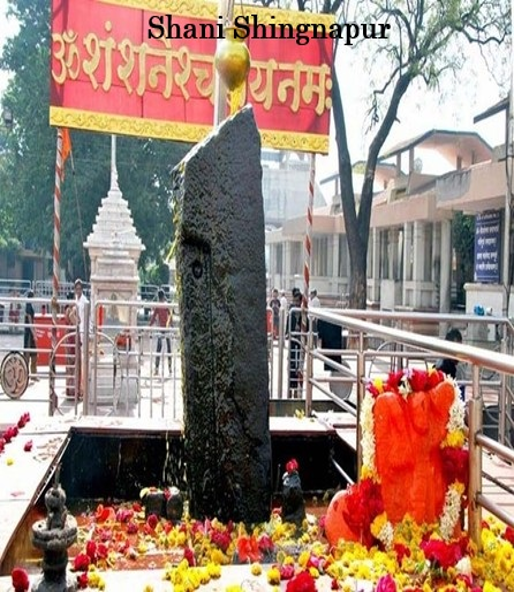
Shani Shingnapur
Shani Shingnapur is a famous pilgrimage village in the state of Maharashtra, dedicated to Lord Shani Dev. The main idol is a black stone slab, situated on an open platform under the open sky. There is no enclosed temple structure here. The homes and shops in the village have no doors or locks. People believe that Lord Shani Dev protects them from theft.
Aanand!!
