

The Journey of Tulsi from Ancient Sanskrit Texts to Modern Holistic Wellness
May 7, 2026
The Journey of Tulsi from Ancient Sanskrit Texts to Modern Holistic Wellness If you were to walk through the bustling…
During the cosmic churning of the ocean (Samudra Manthan), when gods and demons labored together to extract Amrita – the nectar of immortality – it was the demons (Asuras) who seized it first. To restore cosmic balance, Vishnu Bhagawan manifested the most captivating Mohini form to grace existence – incomparable in beauty, grace, and mesmerizing power. The demons, enslaved by desire, surrendered the nectar to Mohini.
By distributing the nectar only to the devas, Vishnu Bhagawan restores balance in the universe reminding devotees that righteousness is sometimes upheld through subtle, even paradoxical means. Mohini Narayan teaches that the world we perceive may be enchanting, even misleading, but it ultimately serves a higher cosmic order. The same illusion that binds can also liberate, depending on awareness.
Mohini is Maya in its most sublime expression. Mohini teaches that beauty itself, when absolute, becomes a doorway back to the Divine, but only if the beholder has the eyes to see through rather than at it.
Vishnu Bhagawan, the sustainer of the universe takes a Mohini form to restore Dharma – right cosmic order. The nectar (Amrita) represents both literal immortality and the eternal truth that must be preserved and given only to those worthies to receive it.
Vishnu Bhagwan sent Mohini – grace, beauty, and love. This is the heart of Vaishnavism: The Lord will take any form to protect His creation. The gods who received the nectar represent souls who, through devotion and surrender, receive Amrita – the bliss of liberation.
The Mohini Avatar is a masterclass in Viveka (discernment). The Asuras possessed power, but not wisdom. The Vedantic teaching here is piercing: desire itself, not the desired object, is the cause of bondage.
The Story of The Sacred Pot, A Divine Metaphor for the Human Body
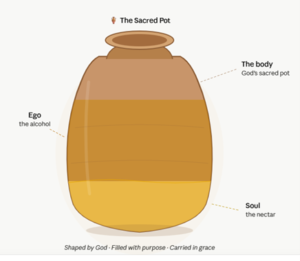
In the workshop of the Divine, before time had learned to count its own hours, God reached into the earth – into the very clay of existence – and shaped a vessel. Not a throne. Not a temple of gold. A pot. Humble. Round. Imperfect at the edges. Breathtaking in its purpose.
This pot is you. This pot is me. And into this sacred pot, two powerful liquids exist.
The First is Nectar (અમૃત, આત્મા):
Deep at the bottom of this vessel, is something luminous, still, does not shout nor compete. It simply is. This is the soul – the divine nectar, a drop poured from the ocean of God Himself. Ancient. Eternal. Untouched by the hands of sin, suffering, pride or fear. The nectar does not age when the pot cracks. It does not sour when the world grows bitter. It carries within it the fragrance of its Origin – of Love, of Light, of the Infinite.
The Second is Alcohol (મદિરા, અહંકાર):
But the pot is NOT with nectar alone. It has ego – the intoxicating, burning, restless, always seeking more, glorious & dangerous liquid of self, the “I”. It clouds vision, distorts reality, and makes us forget the sacredness within.
Ego, when it overflows (when it drowns the nectar), it makes the pot forget what it is carrying. The ego roars and the soul whispers, and in the noise, we mistake the container for the content, the body for the being, the self for the Self.
We live in the age of Mohini.
In a world of infinite scroll and manufactured desire, the practice of Viveka – pausing, discerning, choosing consciously – is itself a spiritual act. Every time you choose depth over distraction, truth over trend, stillness over stimulation, you are receiving the Amrita. You are the god who gets the nectar.
Here’s the deeper truth:
Not everything that attracts you is meant to distract you.
Sometimes, it’s there to reveal you.
So, the question isn’t: “Why is the world so distracting?”
The real question is: “Am I awake enough to not be deceived?”
Vishnu Bhagawan, in his infinite wisdom, does not ask you to become ascetic or joyless. He asks you to become awake. That is Mohini’s gift to the modern soul.